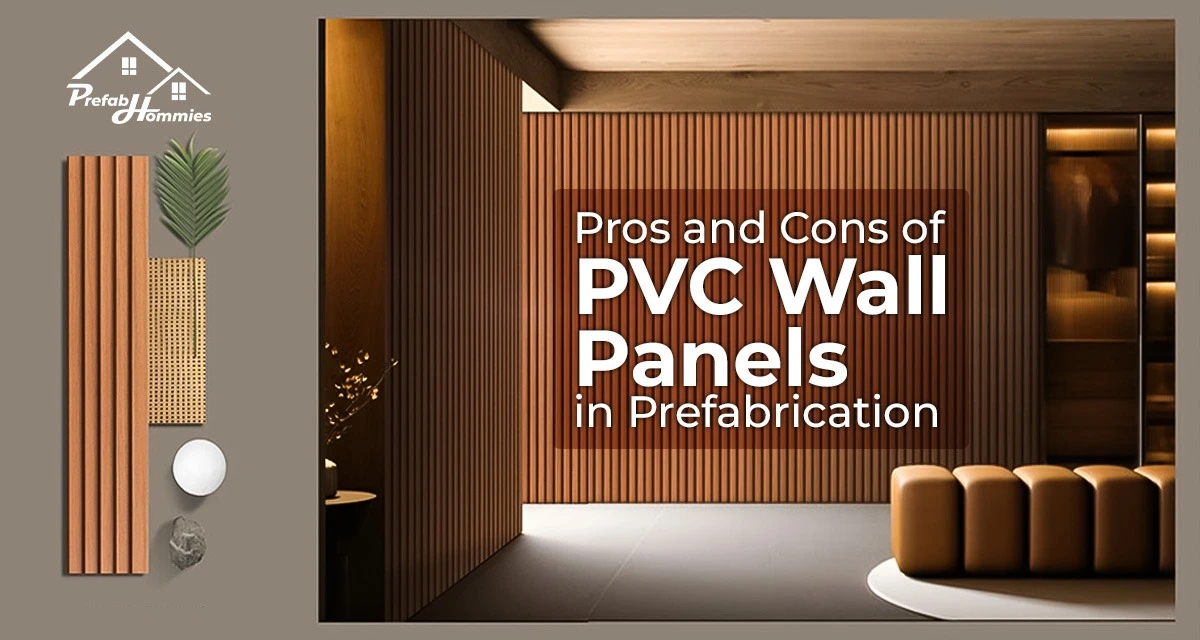
The construction industry has undergone tremendous changes over the last few years, especially with the advent of prefabricated constructions. From prefabricated residential buildings to offices, portable cabins to modern prefabricated houses, the use of prefabricated buildings is becoming a viable alternative in the industry.
Now in the prefabricated structure industry, one of the materials that has attracted a lot of interest and attention is the PVC wall panel due to its durability, lightweight and easy-to-install features.
Like any other material used for construction, PVC wall panels come with their own set of advantages and disadvantages. If you are planning to construct a prefabricated structure, the pros and cons of PVC wall panels in prefabrication can be of great help to you.
Thus in today’s blog, we shall explore more about PVC wall panels, the reasons for using them for prefabricated construction as well as the key benefits and drawbacks you should consider.
PVC wall panels are interior wall finishes made of Polyvinyl Chloride (PVC), a highly durable form of plastic. They are designed to be lightweight, long-lasting and simple to install.
Unlike traditional wall finishes such as plaster, paint or tiles, PVC wall panels are provided as pre-fabricated sheets or interlocking panels. This allows them to be quickly installed.
PVC wall panels can be used for the following applications in prefabricated construction:
Due to their flexibility and ease of use, PVC wall panels have gained immense popularity as a wall finish material in prefabricated construction, especially in modular houses, portable cabins and prefabricated structures.
Prefabrication emphasises speed, efficiency and the use of minimal work on the site. The materials used for prefabrication must be easy to move, easy to install and strong enough to last for many years.
PVC wall panels satisfy many of these requirements which is why builders often opt for them for prefabricated projects.
A few more reasons for the popularity of PVC wall panels for prefabricated structures include:
These features of PVC panels for prefabricated homes make them a viable choice for both commercial and residential prefab structures.
Now let’s explore some of the key advantages that make PVC panelling a good choice for many prefab building projects.
The biggest advantage associated with PVC panelling is that these panels can be installed very easily.
Unlike other wall installation techniques that require plastering, painting and drying, PVC panelling comes ready to install.
Their installation process is very simple and can be completed in a short time by:
This reduces construction time significantly, making prefab projects faster to complete.
In prefabricated construction methods, materials are often transported on site in the form of pre-made pieces. Heavy materials can increase transportation costs and make installation more difficult.
PVC panels are lightweight compared to other wall materials. This means that PVC panels are easier to:
These features make PVC panels suitable for prefabricated structures because efficiency is a key aspect in prefabricated construction.
PVC panels are highly resistant to moisture and humidity. It makes them perfect for places where other materials may not last for a long period.
They are commonly used in:
As its material does not absorb water, it helps prevent issues like dampness on walls and the growth of fungus.
Another major advantage is that PVC panel maintenance is minimal.
Unlike a wall that is painted and may require frequent repainting or even repair in some cases, PVC panel maintenance is easy.
For instance, one can just wipe the panel and keep it in a new condition.
This makes them a convenient choice for prefab buildings that require durability and minimal maintenance.
Currently, modern PVC panel designs come in various styles such as:
All these styles enable builders to design modern home interiors without the need to spend huge amounts on materials.
Although PVC panels have a number of advantages, it is necessary to look at their disadvantages as well, especially when deciding on their usage in a project.
PVC panels are designed for wall cladding and finishing, not for structural purposes.
This means they cannot be used as a substitute for structural walls made of concrete or bricks.
Thus in prefab buildings, they are normally used for finishing purposes, not for structural purposes.
PVC is a plastic-based material which means it may not perform well under extremely high temperatures.
Exposure to heat over time may result in:
For these reasons, proper planning is required when installing PVC panels in areas that are exposed to direct heat sources.
Another factor that must be considered is the environmental impact of these PVC materials.
Although these materials are strong and long-lasting, PVC is a synthetic product that is not as environmentally friendly as some natural alternatives.
Nevertheless, current manufacturing techniques are slowly making these materials more recyclable.
PVC panels are used for interior walls.
For exterior walls, builders prefer materials that are capable of resisting:
Thus, in most prefabricated structures, PVC panels are used inside the building rather than on the outer walls.
Quick Comparison: Pros vs Cons
Here is a simple comparison that will help you understand the benefits and limitations of PVC panels:
Pros | Cons |
Quick installation | Not suitable for structural support |
Lightweight and portable | Can be sensitive to high temperatures |
Moisture resistant | Environmental concerns |
Low maintenance | Limited exterior applications |
Variety of designs | May not match the durability of concrete |
This comparison will help you, as a builder or homeowner, determine if you can use PVC panels for your specific prefab project.
The prefabricated method of construction has been gaining popularity over the years due to its efficiency, speed and cost-effectiveness. As discussed in the article, the PVC wall panels in prefabrication offer many advantages such as easy construction, lightweight, resistance to moisture, etc. This makes the PVC wall panel a good option for interior wall finishing for modular buildings.
But the pros are not the only factors to be considered, as there are a few cons too which are the low strength of the materials used as well as the materials’ susceptibility to extreme heat. Hence, both the pros and cons need to be taken into consideration while making a decision.
Companies such as Prefab Hommies are dedicated to providing prefab building concepts that combine modern materials, smart design and efficient construction techniques. By using quality materials such as PVC in strong structural frames, we can provide prefab homes and structures that are efficient, practical and relevant to the needs of the modern era.
Read More:- Why PVC Panels Are a Better Choice Than Traditional Wall Paint
Yes. Modern prefabricated structures are engineered using high-quality steel, insulated panels and advanced materials that ensure long-term durability.
Absolutely. They are designed to withstand varying climatic conditions including heavy rainfall, snow and heat.
In most cases, yes. Faster timelines and reduced labour costs make it an economical solution.